
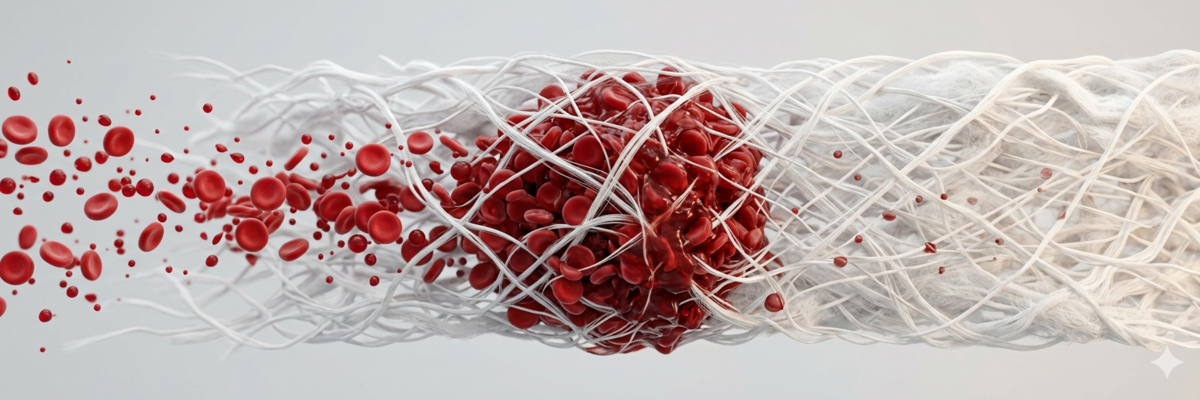
What Is a Hemostatic Agent
A hemostatic agent is a product that accelerates the body's natural blood clotting process and stops bleeding. It does not simply compress the wound — it triggers a chemical reaction directly inside the wound channel.
Picture an ordinary gauze bandage impregnated with a substance that accelerates natural blood clotting by tens of times. You pack it into the wound, apply pressure — and instead of waiting several minutes, the blood clots in 30–60 seconds. That is what a hemostatic bandage is.
How Blood Stops: No Unnecessary Biology
When you cut your finger at home, the bleeding stops on its own within a few minutes. The body launches a cascade of chemical clotting reactions: blood vessels constrict, platelets aggregate, a clot forms.
With a massive wound, however — an arterial hemorrhage, a deep wound channel — the body cannot form a clot in time. Blood pressure is too high; blood flows out faster than it can clot inside the wound. The casualty may lose consciousness within a minute or two.
A hemostatic agent delivers a concentrated clotting "catalyst" directly to the wound. The two most common types are:
- Kaolin (an inert clay-based mineral) — activates clotting factors regardless of the patient's body temperature or condition. This is the same principle behind the NATO standard, QuikClot Combat Gauze. BloodSaver hemostatic bandages are built on the same foundation — kaolin technology, manufactured in Ukraine.
- Chitosan (a substance synthesized from crustacean shells) — attracts red blood cells through opposite electrical charges, forming a gel-like clot. Both types are effective. What matters is that hemostatic bandages are in your IFAK (Individual First Aid Kit).
How a Hemostatic Bandage Differs from an Ordinary Bandage
An ordinary bandage is just fabric. It absorbs blood but does not accelerate clotting. With massive hemorrhage it will be soaked through in 20–30 seconds and accomplish nothing beyond the illusion of action.
A hemostatic bandage is an active agent. It:
- is impregnated with a substance that accelerates blood clotting 2–5 times
- is folded in a Z/N-fold configuration for rapid one-handed deployment and convenient wound packing
- is designed for deep wound-channel packing
- remains effective even when thoroughly saturated with blood
- retains effectiveness at temperatures from −40°C to +50°C (−40°F to +122°F) — in winter field conditions and inside armored vehicles in summer
When to Use a Hemostatic Bandage
A hemostatic agent is not a tourniquet replacement. It is a complement to the tourniquet, used within the MARCH protocol. Here is when it is needed:
A tourniquet cannot be applied to wounds:
- in the groin or perineum
- in the axilla (armpit)
Other situations where a hemostatic agent is used:
- surface wounds with heavy bleeding — lacerations, fragmentation injuries where a tourniquet is not appropriate.
- Tourniquet conversion — when evacuation is not possible within 2 hours and conditions are safe for the provider, a medic may convert the tourniquet to preserve the limb. This requires tightly packing the wound with a hemostatic bandage, applying a compression bandage, and then carefully loosening the tourniquet (slowly, no faster than one full turn per minute, while monitoring for sudden return of bleeding).
How to Apply a Hemostatic Agent: Step by Step
These instructions are written for a soldier without medical training. Follow the sequence:
- Put on gloves.
- Locate the bleeding source. If necessary, cut away the casualty's clothing to expose the wound. Wipe the wound with clothing or a cloth to see exactly where the blood is coming from. Press your hand over the wound to slow bleeding while you retrieve the hemostatic agent.
- Open the packaging. Tear along the tear line. Do not waste time being careful.
- Pack the bandage into the wound channel. The hemostatic agent must go inside the wound, not on top of it. Begin packing from the source of bleeding. Pack tightly. If the channel is deep, press the bandage in with your fingers and keep packing. Do not hesitate — act decisively. Continue packing until the bandage (the packed hemostatic material) protrudes 2–3 cm above the skin surface.
- Apply and hold pressure. Press continuously on the wound for a minimum of 3 minutes — no pauses to check whether the bleeding has stopped. Releasing too early will break the clot before it has time to set.
- Apply a pressure dressing. Place a compression (Israeli) bandage or another pressure dressing over the hemostatic packing.
- Evacuate. A hemostatic agent is a stabilization measure, not definitive treatment. After application, evacuate the casualty to medical care as quickly as possible.
BloodSaver: A Ukrainian-Made Hemostatic Agent
Most hemostatic products on the Ukrainian market are imported. American QuikClot Combat Gauze costs over $40 per bandage. HemCon and Celox are in the same price range. For large-scale unit equipping, that is prohibitively expensive.
BloodSaver is a hemostatic bandage made by a Ukrainian manufacturer. It was developed as an affordable NATO-level alternative for mass equipping of the Armed Forces of Ukraine / National Guard of Ukraine, special services, volunteer medical groups, and civilian first aid kits.
Key facts about BloodSaver:
- Manufactured in Ukraine — no import dependency, reliable supply
- Kaolin-based — the same mechanism of action as Combat Gauze (NATO standard)
- N-fold format — deploys one-handed even with gloves on
- Designed for bulk procurement — military units, NGOs, medical depots
- Developed incorporating real combat application experience
Wholesale pricing and supply terms for distributors are available at bloodsaver.net.
What to Check When Choosing a Hemostatic Bandage
The market is saturated with counterfeits and ineffective products. Here is a short checklist to help you choose a quality hemostatic agent:
- The active ingredient is stated on the packaging — kaolin, chitosan, or ORC. If the composition is not listed, do not buy it.
- Shelf life — at least 1.5 years remaining.
- N(Z)-fold bandage, not a roll. The N-fold format allows convenient wound packing without unrolling the entire bandage.
- Certification or registration — a medical device must have the appropriate regulatory documentation.
- Manufacturer's registered address and contact information — who is legally accountable and handles complaints.
- Original packaging is undamaged.
IFAK: Where to Carry Your Hemostatic Bandage
A hemostatic bandage is one of the essential components of an individual combat medical kit, alongside a tourniquet.
Recommendations:
- in an external pouch on your plate carrier or chest rig — accessible with one hand
- not in a backpack, not at the bottom of a pouch
- check the packaging weekly: if damaged, replace it
Frequently Asked Questions (FAQ)
Can a hemostatic agent be used without medical training?
Yes. A hemostatic bandage is designed for use without specialized training. The key steps are: find the bleeding source, pack the bandage firmly, and hold pressure for a minimum of 3 minutes. Taking a basic Stop the Bleed or ASM course will take a few hours and could save your life or someone else's. Follow TCCC (Tactical Combat Casualty Care) guidelines.
Can a hemostatic agent be reused?
No. It is a single-use device. Once it has been in contact with blood, it must be disposed of.
How long does a hemostatic agent stay in the wound?
Until surgical intervention. Surgeons remove it in the operating room. Do not attempt to remove it yourself — doing so may trigger fresh bleeding.
Is packing a wound with a hemostatic agent painful?
Yes, it is painful. But massive hemorrhage is lethal, so it must be done. If the casualty is conscious, warn them and proceed.
What is the difference between chitosan-based and kaolin-based hemostatic agents?
Both are effective. Kaolin (as used in BloodSaver) works by activating clotting factors regardless of the patient's body temperature or physiological state — an advantage in hypothermia or shock. Both types meet TCCC standards.
Can a hemostatic agent replace a tourniquet?
No. For limb hemorrhage involving major vessels, apply a tourniquet proximal to the wound first. A hemostatic agent is necessary for wounds where a tourniquet cannot be applied, or as a supplement to one.
Can a hemostatic agent be used in an abdominal wound?
Penetrating abdominal wounds require a separate management protocol — consult your unit medic. For surface wounds on the abdomen, yes, a hemostatic agent is used.
Where can I order BloodSaver hemostatic bandages wholesale?
Bulk orders and unit supply — via bloodsaver.net or through the contacts on the Distributors page.